
Holding onto Summer: mixed-media flower drawings
Updated: Jan 27

Over the cold, dark days of late December and early January, I’ve been working on a new drawing project to study flower forms in more detail and find ways to render them within a natural background context.

It’s rare for me to work from photographs. I take many, but usually end up not looking at them while I work, instead creating idealised shapes and structures. This works well for simple landscape compositions, but the thick tangle of flowers, leaves and stems in a garden, meadow or hedgerow poses a particular challenge that I’ve wrestled with for the past three years. What should be included, and what left out? How do you simplify complex forms? How do you keep the colours of the petals clear and bright while still giving a sense of background and context?
I took many, many photographs of my garden, allotment and open gardens I visited during the summer. In the dark winter days in the North East of England, they bring back memories of sunshine and lush midsummer growth. What better time to revisit them and have a go at rendering them in new ways?

I’ve approached this conundrum—how to paint flowers in context—from a number of different angles and by looking at how other artists handle it. Tessa Pearson, who works in watercolour, paints the floral shapes first and then paints the background around them. For painters using acrylic, the usual method is to lay down thick, opaque paint over a background. I’ve been using collage shapes to achieve really sharp colour distinctions between flowers and their surroundings. But the luminous colour of flowers always seems to fade when translated into paint...

I had a penny-dropping moment after my drawing holiday in Scotland, when I realised how I could use mixed media to interpret flowers in the context of a garden. By combining ink washes, coloured pastels and charcoal, I could “carve out” the flower forms by rubbing away the pastel. This process is very addictive and has a lot in common with the negative mark-making I use in my monotypes. I then add highlights and darker lines with black and white pens.

You can see each of the drawings I’ve done so far alongside the photograph I was working from. I used the widest camera setting on my phone, which gives a great, elongated rectangle. I cut the paper to match the same aspect ratio which helps with drawing things proportionally i.e. if a flower fills 1/4 of the height of the photograph then it will be 1/4 the height of the paper: I don't trace the photograph. I tried using a tablet and pen to create a digital drawing directly from the photograph but all the life went out of it and I felt I was compromising my creativity.

From the courses I’ve attended, I’ve learned that when you’re faced with a complex subject it helps, before you begin, to think carefully about what matters most to you in the scene. What do you want to focus on, and what areas can you afford to simplify or gloss over?

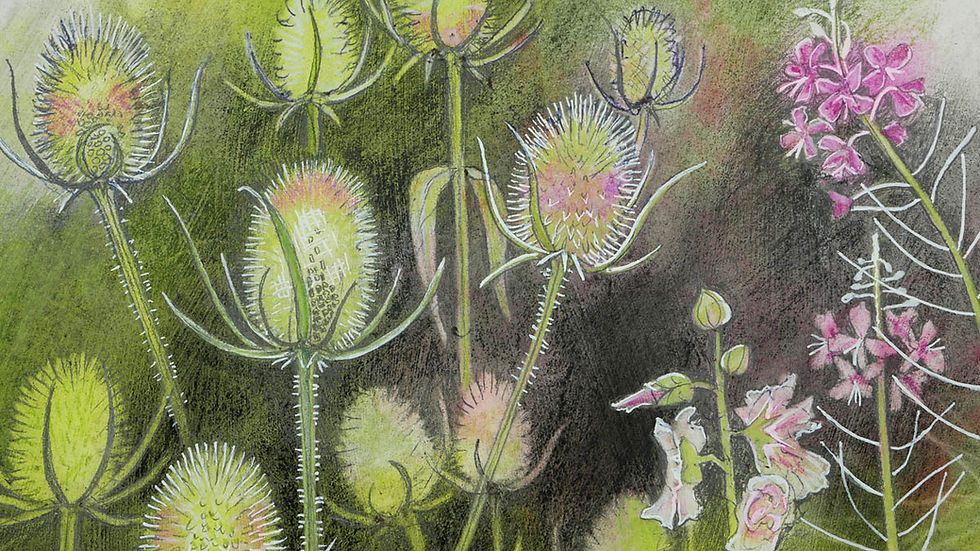
For the Teasels drawing (top), my focus was on the contrast between the solid, spiky forms of the teasels and the light, delicate lines of the rosebay willowherb (also known as fireweed). The pink and lime-green colour contrast, along with the deep shadows behind, were also important. The foreground and background leaves are only lightly suggested.

For these drawings I worked at my desk in the evenings rather than in the studio, just doing a little at a time. When you’re working outdoors, you’re often uncomfortable and under time pressure, so it was relaxing to work more slowly, with breaks to rest and reflect. I think it’s easy for artists to fall into a productivity trap—counting the hours spent and rushing to finish work like an efficient production line!

I’ve been thinking a lot about the creative life and how we can nurture it. I’ve read books such as Meditations for Mortals by Oliver Burkeman and listened to podcasts like The Deep Life to get ideas about how to focus more deeply on my work and give it the time it needs to reach the highest standard I’m capable of. It really comes down to this: life is short, and our time is finite. If we fritter it away on Netflix and social media, we’ll never get where we want to go.

I’ve taken social media apps off my phone and now keep it in the kitchen in the evenings. I occasionally watch a film with my husband and sons, but television isn’t really part of my life. Any time I can free up for reading, exercising, being in nature or drawing feels far more valuable. More than that, though, it requires planning ahead, keeping promises to yourself, and developing habits and rituals that support creative work. I used to say I was too tired after dinner to do anything creative, but it turns out I was mostly just distracted and taking the easy option of scrolling on Instagram. Cultivating a creative life begins with these small, mundane decisions and intentions.

After that little philosophical diversion, let’s get back to the drawings! Another important aspect of these compositions is the sense of focus and depth in space. With a camera, you can use a shallow depth of field so that some areas are sharp while others are soft and blurred. I wanted to echo that effect in the drawings. Some flowers are crisp and detailed, with strong colour and contrast sharply against their backgrounds. Others are softer and more vague, with less contrast and detail.

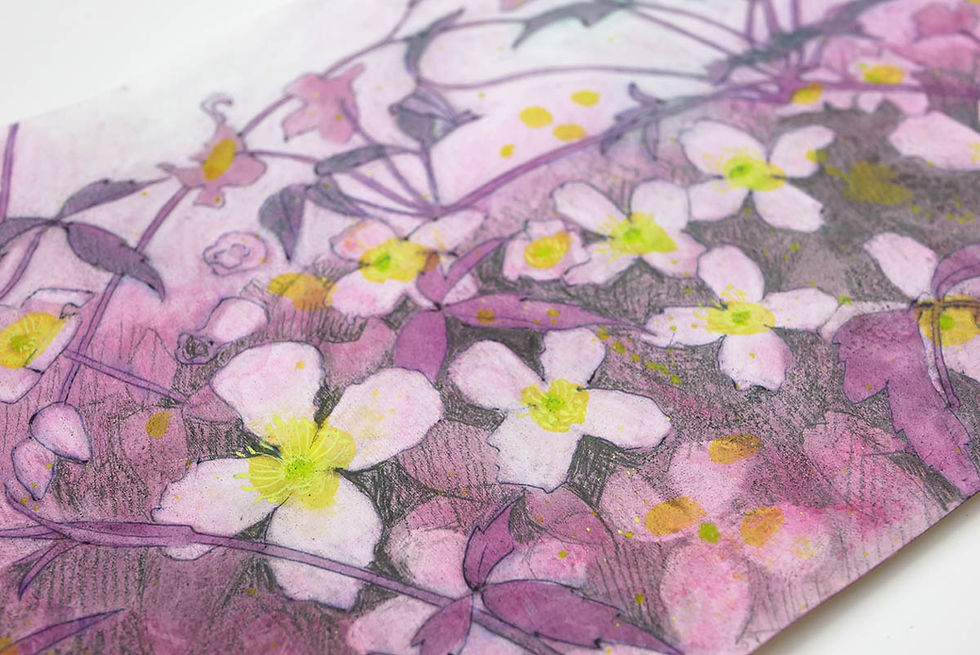
For the backgrounds, I wanted to be really loose and just suggest light and dark and loose areas of colour. In the Rudbeckia (Black-eyed Susan—this one is the green ‘Irish Eyes’ variety), I wasn’t interested in drawing the fence behind the flowers, so instead I created a loose colour field of mauve, black and green to push the warm golds of the flowers forward. I was particularly pleased with the daisies drawing, where I was able to focus on the foreground flowers and simply suggest the more distant ones with areas that have been rubbed back.


I’m hoping this drawing practice will feed directly into my painting. It would also be interesting to see how it could translate into monotype, as there are clear parallels. I have so many photographs I’d like to explore in this way, but I’m also looking forward to spring and summer, when I can draw outdoors again. I may even buy some flowers from a florist - working from real plants always has a vitality and presence that photographs can’t quite match.
Although these mixed-media flower drawings were made primarily for my own development and practice, I’m happy to offer them for sale - just get in touch (info@rebecca-vincent.co.uk or phone/text 07717256169) if you’re interested in a piece or would like to discuss framing options. And do join my email list if you’d like to follow this creative journey and be among the first to see new work.


Just discovered your work, I'm drawn to the clean lines and wonderful colours. Really striking and inviting the gaze. Thanks.
I love these so much!
Beautiful! These new floral art pieces are gorgeous!
Thank you for sharing your process and discussion about your work. I really love the art work that you do. Thank you
Rebecca.
As a pastelist, that also does pen and ink/watercolor washes, I just love these paintings in this post. Lovely!
This was a wonderfulway to spend your winter. Keep on.