
Layers of Possibility: printmaking for collage course

It's been an eventful month for me, with my second (and last!) child heading off to university. I also attended a much-anticipated course at The Lund Studios with collage artist Sally Hirst.
My son's departure brings a mixed bag of feelings: relief that he's going somewhere he's happy with; excitement for him as he starts a great new adventure; fear that something awful will happen when he's away; pride in his achievements and personal development; sadness that he's not at home with us; and eagerness about the next phase in my own life.
My creative life has run alongside family life for more than two decades, and I'm sure it will continue to do so, but not having children (however big!) at home does change things significantly. It opens up time to think, plan and work in a more focused way. I was a full-time artist before motherhood, but my focus then was more on teaching, and I probably didn't appreciate how much free time I had back then! So I'm really looking forward to having more time to think and develop my work.
Taking on new creative challenges and stretching myself artistically has become increasingly important to me in recent years. It was with this in mind that, a year ago, I signed up for Sally Hirst's course, Printmaking for Collage – an artist's approach to combining processes at Lund Studios. Sally is a very popular collage artist who teaches mainly online these days, so it was a rare and exciting opportunity to learn from her in person.
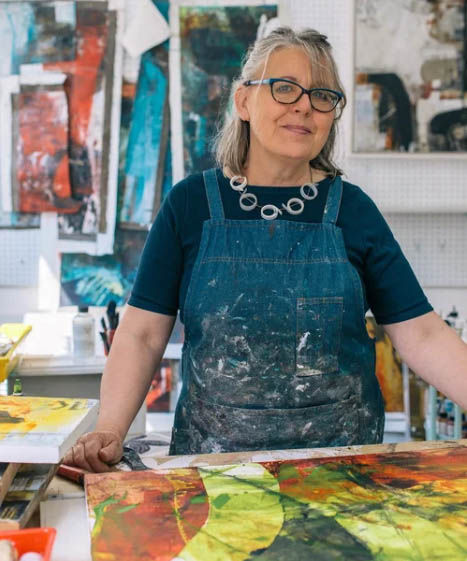
The course was so popular that it sold out in five minutes! I wanted to attend because I'd been so impressed by the depth of Sally's knowledge – not only about materials and processes, but also about the principles of composition and the creative process. Her knowledge comes from many years of research and professional practice. Do check out her work on her website and Instagram. Her new book, also called Printmaking for Collage, will be available from late October this year.


I've been a printmaker all my working life – now more than 30 years – but Sally brings a very different perspective, with a focus on making collage papers through water-based printmaking methods onto very thin paper that can then be collaged in multiple layers. As I've been experimenting with collage in my paintings, this seemed like the perfect next step in my creative development. I love learning new processes and meeting lovely creative people, so I drove down to Yorkshire with great excitement.

The course certainly delivered, with three days packed with demonstrations and a wealth of information. Sally is a walking encyclopaedia of materials, methods and approaches. She's also incredibly witty, unpretentious and bubbles over with enthusiasm for her subject!
The course attracted professional artists and serious amateurs who already had a lot of experience. Much to both our surprise, I ran into my friend and colleague Carol Nunan, with whom I shared a studio for seven years! Having taught printmaking ourselves for many years, we had a deep appreciation for the preparation and planning that had gone into the course. Sally had brought mountains of materials, all prepared for use in a well-structured format.

The first two days were devoted to printing on teabag paper using a variety of tabletop methods, as well as some intaglio printing using a press. Intaglio simply means that the printing ink goes into the grooves on a textured or indented plate. I was intrigued by the extremely light "teabag" paper, which I'd never seen before (except in a packet of tea!) let alone printed on. My biggest takeaway from the course – and there were many – was that you could use its translucency to apply layer upon layer of texture and line. It's a kind of indirect painting.

I'm not going to go into all the methods and materials here – you can buy Sally's book or sign up for one of her online courses if you want to know the details. (I'm afraid next year's course at The Lund has already booked up, but there is a waiting list.) You can see (above) the collage papers I produced. I used a colour theme from a project I started a couple of years ago, based on a cemetery in Nottingham where the pale grasses and yellow ragwort flowers made an amazing contrast with the slate-grey gravestones.


The backing sheets we worked on were covered with accidental marks (below), which were then used to create new compositions. We all enjoyed seeing one another's backing sheets, as each one had a distinct personality, with its own colour choices, shapes and marks.

I loved being surrounded by such creative people. It's incredibly inspirational and encouraging to know that there are artists like me working away in their studios and wrestling with some of the same challenges. Our lunchtimes were a great opportunity to exchange stories about our lives and work.

On the third day, we used our papers to make our own collages – first with an irregular edge (at the top of this post), and then on two wood blocks, which I completed later in my studio. I also came away with several pages of notes and lists of materials. I particularly want to buy the teabag paper as an alternative to the wet-strength tissue and rice paper I've been using recently.

While you can paint collage papers directly, the indirect printing and collaging techniques Sally showed us have a lightness of touch and style of mark that is quite unique. I was particularly taken with linear marks and shapes with negative spaces that melt away when they're glued in place, revealing the underlying colours.

I think this will feed into my floral paintings, giving a sense of criss-crossing stems and multiple layers of foliage. It can be hard to paint thin, pale lines that show up well, so this method could be particularly effective for sun-bleached grasses. There's also a lot of flexibility in where you place the collage piece, with the option of repositioning if you're not happy with it.

I came away with a new respect for the depth of layering that Sally creates in her own work, and a desire to use these techniques in larger paintings on wood panel or canvas as I expand the range and ambition of my artistic practice.

I've probably attended a dozen professional practice courses now, and each one brings something new to my artistic process. But more than that, they give me a great deal of enjoyment and time for dedicated creative development, along with the pleasure of spending time with a fantastic bunch of people.
If you'd like to read more blog posts like this one and be among the first to find out about the new work I produce, please sign up to receive my emails - in the footer below, at top of page or in the pop-up box.


Comments